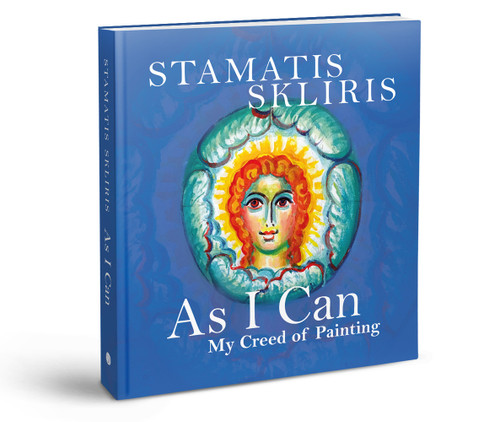
As I Can: My Creed of Painting
- Author:
- Father Stamatis Skliris
- Editor:
- Bishop Maxim Vasiljević
- ISBN:
- 978-1-964233-41-3
- LCCN:
- 2026946182
- Book Details:
- Hardcover · full color · 8.7 × 8.7 × 0.7 in · 1.6 lb · 227 pages · English · Publisher: Sebastian Press · 2026


As I Can: My Creed of Painting is a deeply personal reflection by renowned Orthodox iconographer and painter Fr. Stamatis Skliris on a lifetime devoted to the mystery of artistic creation. Blending memoir, aesthetic meditation, theological insight, and practical reflections on painting, the book explores the relationship between beauty, light, freedom, authenticity, and the human person. Enriched by essays from leading artists, theologians, and critics, and illustrated with a rich selection of the author's paintings and icons, it offers a unique window into the creative vision of one of the most influential Orthodox artists of our time. More than an artistic manifesto, As I Can is a spiritual and philosophical journey into the vocation of seeing, creating, and revealing life through color and form.
Prelude
Yannis Tsarouchis once said to Alekos Fassianos, “I paint as I can.” At the time, Tsarouchis faced a particular challenge: abstraction was sweeping across the Western art world. Compared with many European painters of that period, he appeared almost “classical.” At one point he even tried painting abstractly himself, but it simply was not true to his nature. So he said, quite simply, “I paint as I can.”
Fassianos himself told me this story, adding something profoundly important: “Paint as you can. In the as you can lies your authenticity.”
In other words: this is how you are able to paint; this is how you create. That is where the truth lies. If you try to do what you are not called to do—as Tsarouchis did when he attempted abstraction—authenticity disappears. From there one steps onto a slippery path, creating merely to resemble the Frenchman, the abstractionist, or the cubist. In the end, you become none of these. You are neither cubist nor abstract. You become simply an imitator—and eventually you lose everything.
Fassianos said this with remarkable simplicity. I still remember the moment. I was driving us home after dinner at a small tavern, and he spoke these words almost in passing. Yet for me they carried immense significance.
Years later, while a filmmaker in Belgrade was making a documentary about my work, we returned to that conversation. He chose As I Can as the title of the film. Once again, I found myself reflecting deeply on the question of authenticity.
Some time afterward, George Papageorgiou gave me a copy of Picasso’s Thoughts on Art. For me, it was a stunning book—almost as though one were adding a fifth Gospel, not to Christianity but to art. Just as Christianity has its four Gospels, this seemed like a fifth: a visual gospel of artistic creation.
From that point on, the question of authenticity became an even deeper concern, especially after Fassianos's passing. With his departure, the beautiful evenings we had shared also came to an end. Every day he painted from eight in the morning until eight in the evening. By nightfall he was exhausted and wanted to relax. He would invite a small circle of friends—never quite the same group twice—and together we would go to a modest, picturesque tavern to eat, drink, and talk.
Many reflections were born during those evenings. Fassianos himself, however, rarely analyzed such matters at length. He was a man of few words—a man of action and of painting.
It was then that my own reflections on authenticity in painting began to take shape. Many years later, in 2025, I attempted to distill them into a brief, emblematic text entitled The Creed of Painting, which you will find later in this book.
Athens
March 11, 2026