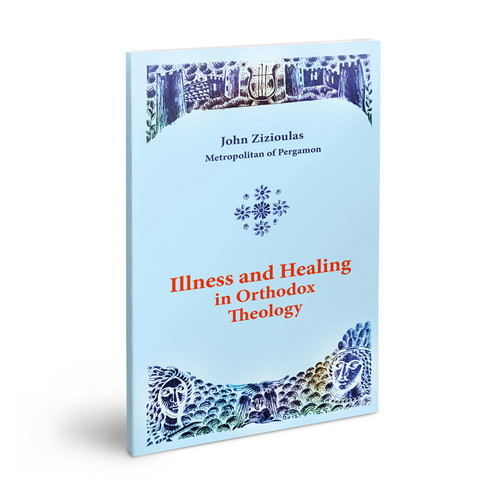
The basic questions the author answers for discussion are: What, in general, is sickness, and what, specifically, is mental illness? What is therapy and what is a cure? When can we say that someone is healed or cured? What means or methods do we have at our disposal to effect treatment, as this is understood by theology? John Zizioulas provides answers to the questions based on certain fundamental principles of Orthodox theology. Among the Fathers of the Church, he turns particularly to St. Maximus the Confessor, a father of the 7th century.
For St. Maximus, the essence of sickliness is self-love. Self-love is not simply a passion: it is the root cause of all passions: If you want to be liberated from the passions, cast off the mother of the passions, self-love. The only real healing lies in the eradication of self-love, which is the root of all the passions. The only way to separate a passion from a “representation” is with love, self-restraint (i.e., self-mastery), and free will. On this point, theology can offer us some crucial principles.
Author:
Metropolitan John D. Zizioulas
Illustrator:
Fr. Stamatis Skliris
Translator:
J. W. Lillie
ISBN:
978-1-936773-26-8
Book Details:
Paperback · duotone · 4.3 × 7.5 × 0.15 in · 0.2 lb · 53 pages · English · Publisher: Sebastian Press · 2016
John D. Zizioulas (1931–2023), a renowned modern theologian and former Metropolitan of Pergamon in the Ecumenical Patriarchate of Constantinople, is known for his significant contributions to Christian theology. He earned his doctorate in theology from the University of Athens and held academic positions at various universities. He was a professor of Systematic Theology at the Universities of Edinburgh, Glasgow, and Thessaloniki and a visiting Professor at King’s College in London. Metropolitan John became a regular member of the Academy of Athens in 1993 and its president in 2002–2003. His extensive ecumenical involvement and scholarly work resulted in several influential publications, solidifying his reputation as a leading Orthodox theologian of our time. He is generally recognized as the most brilliant and creative theologian in the Church, dealing with the most contemporary issues facing humanity today. Аt the culmination of his theological journey, John Zizioulas, has bestowed upon the academic world his magnum opus, a work that surpasses all his previous endeavors in depth, insight, and scholarly rigor. The insights presented in his celebrated Being as Communion and Communion and Otherness provided the groundwork for the extensive exploration undertaken in this seminal piece that will likely be dissected and referenced even more extensively than the author’s prior contributions. This Zizioulas’ work presents a holistic Christian “theory of everything,” as he underscores how eschatological ontology deeply influences the entirety of Christian doctrine. Metropolitan Zizioulas acknowledged the profound challenge of articulating the influence of the future on the present. In 1999, he remarked, “I realize that this concept is most difficult to grasp and to experience,” attributing this difficulty to the fact that “we still live in a fallen world in which protological ontology is the dominant form of rationality.” The future of things in this perspective is defined by its origins and the “given” or the “factum.”