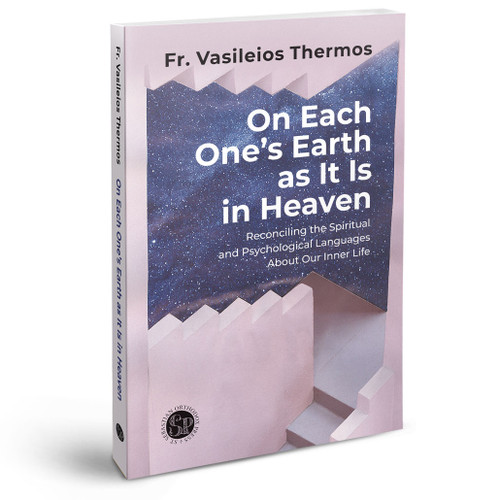
On Each One’s Earth as It Is in Heaven: Reconciling the Spiritual and Psychological Languages About Our Inner Life
- Author:
- Fr. Vasileios Thermos
- ISBN:
- 978-1-964233-32-1
- Book Details:
- Paperback · black & white · 6 × 9 × 0.5 in · 0.8 lb · 216 pages · English · Publisher: Sebastian Press · 2026


In this groundbreaking volume, Fr. Vasileios Thermos—a practicing psychiatrist and an Orthodox priest—addresses the profound "estrangement" between the vocabularies of theology and psychology. For too long, these two fields have operated in isolation, leaving many believers caught in a painful deadlock: "Is my struggle a sin to be confessed, or a psychological disorder to be treated?".
A Bridge Between Two Worlds
This book is not merely an academic study; it is a vital mapping of the human person in all their "unimaginable complexity". Fr. Vasileios explores how the spiritual life and the psychic life are not independent tracks, but a unified human reality. By bringing neptic patristic terms (like nous, logismoi, and passions) into dialogue with modern clinical concepts (like trauma, depression, and personality disorders), he offers a path toward true inner unity.
Key Insights for Clergy and Laypeople:
- Sins Fueled by Mental Disorders: Understanding how conditions like anxiety, depression, ADHD, and OCD can "contaminate" thoughts and behaviors, often leading to a cycle of guilt in confession that medicine or therapy could help alleviate.
- Borderline Personality & Postmodernity: A deep dive into why borderline pathology has become the "disorder of our times" and how it manifests in the pastoral setting through volatile images of God and unstable spiritual commitments.
- The Tension Between Nature and Will: Clarifying St. Maximus the Confessor’s distinction between the "corruption of nature" and the "corruption of prohairesis" (will) to help discern between moral failings and psychological energy disturbances.
- Clergy and Therapist Cooperation: A call for mutual awareness to remove the biases and "blind spots" on both sides, ensuring that those in suffering receive integrated care for both soul and psyche.
The Eschatological Vision
Ultimately, Fr. Vasileios reminds us that our psychological struggles are temporary. In the Kingdom of Heaven, "ontology will eventually absorb psychology". The goal of this book is to help us labor through our current imperfections toward that final transfiguration where our personal identity is fully fulfilled in Christ.
***
Book Review
Very much like our internet experience of clickbait, modern books often present us with dazzling titles that appear to draw us in with promises that cannot be delivered. This book appears to be the exact opposite. In this relatively short 214-page, but densely packed work, I was deeply engaged in the complexities of Fr. Vasileios Thermos’ exploration of these very demanding topics. The reader is drawn to ponder how we, on earth, as individuals, can be in heaven, and it reviews many extremely important matters between the religious-spiritual and psychological languages by drawing us into the relevant matters related to the practice of faith in dialogue with our modern age of mental health. Our author, imminently qualified both as a Greek Orthodox priest, psychiatrist, professor (both in Greece and abroad), and prolific writer, leads us not only through the intellectual path, but also an experiential one, which I, the reviewer, could not help but be drawn into—both for my edification and benefit! Despite the complexities, I felt down in the trenches.
Warning that the “intersection of these two vocabularies does not imply correspondence,” he efficaciously traces important paths of psychological development, which, when disturbed, do not stem from difficulties of disobedience or moral defiance, but can proceed to unhealthy passions, which in turn can lead to sin. Further, especially with personality problems, after conversion, one progression is when the person aligns their defensive structure with passions that limit their faith. For instance, the obsessive-compulsive personality may proceed to be a standard-bearer, rigorously insisting upon structures, rigidly adhering to the rules, and so on. This part of their personality can remain unchanged and unaffected by grace. Never harsh, our author compassionately shows how persons with these defensive patterns can gradually learn to trust through becoming aware of their daunting scrupulosity and “avoiding errors at all costs” approach. This section on personality helps the reader understand how these psychological challenges can slow or stagnate faith, impeding growth. When individuals are overly defensive, Fr. Thermos thoroughly explores how deeply entrenched defenses, even to the point of suicide, represent efforts to be in complete control, stemming from serious problems with acedia, despair, and so on. These individuals, we learn, completely cut themselves off from God, which ends up being an affirmation of God! With these and many other challenging issues, he equips us with many ways to approach these challenges throughout the book.
However, our author doesn’t just trace these patterns; he aids the clergy and psychotherapist, along with the interested adherent, to consider important issues such as ways to differentiate existential anxiety from neurotic anxieties. Further, he asks important questions to help us think about the difference between demonic and psychological problems. Although open to how these may interact, he competently explores the myriad of complicated matters associated with these important categories. Fr. Thermos also guides us through the cultural, pre-modern, modern, and post-modern sensibilities that affect our view of these topics. Although he develops a section on healthy versus unhealthy religion, our author presents his topics from this perspective throughout. We learn how psychology can aid the Christian in practicing their faith less defensively, and most importantly, how psychology is not a competitor with theology, but can be allied with it when it helps us learn about our human condition, its limitations, and its potential to bring us to where Christ meets us, in our humanity.
Central to this extensive exploration is the relationship between the ontological and the psychological. By using the psychological perspective to enrich our understanding of the human person, he illustrates how God’s grace and love transform the personality. Interestingly, he shows rather convincingly how wayward passions and personality “flaws” can be transformed and sometimes converted into assets, rather than something we might not recognize, or that just erases the personality. In a fascinating discussion, he explores what happens when the true self encounters God. I will leave the reader to find out what stimulating perspectives are found there. Additionally, Fr. Thermos shows us how, in the end, psychology is absorbed into ontology in the eschaton.
I have just scratched the surface of this important and engrossing work. However, I hope I have given the reader a further sense of its importance and contribution. It is the result of decades of clinical and clerical experience, generously leaving us with the author’s years of accumulated wisdom. This book includes many important recommendations for both clergy and mental health professionals. I cannot recommend this book enough for these disciplines, but also for Christians who wish to continue to grow in their life of repentance and life in Christ.