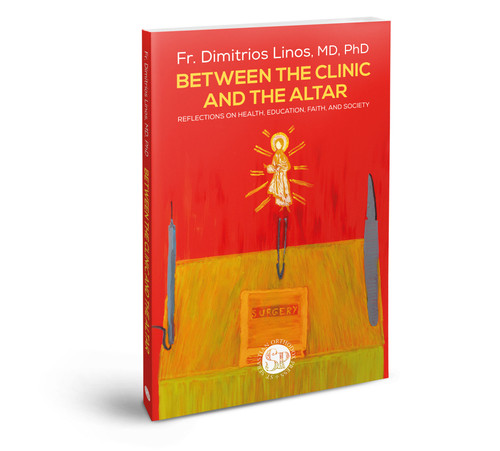
Between the Clinic and the Altar: Reflections on Health, Education, Faith, and Society
- Promotion:
- 15% off at checkout
- Status:
- New release
- Author:
- Fr. Dimitrios Linos
- ISBN:
- 978-1-964233-26-0
- Book Details:
- Paperback · full color · 6 × 9 × 0.4 in · 0.5 lb · 129 pages · English · Publisher: Sebastian Press · 2026


Between the Clinic and the Altar: Reflections on Health, Education, Faith, and Society is a luminous and wide-ranging volume in which Fr. Dimitrios Linos writes from the crossroads where medicine, theology, and public life have always met. Drawing on decades of clinical experience, academic engagement, and ecclesial reflection, the author invites the reader to see health not as a purely technical matter, but as a deeply human, spiritual, and social reality. Structured as a series of short, accessible essays, the book moves freely between the intimate and the global: from disease, aging, stress, and the microbiome to education, fasting, forgiveness, political theology, biogenetics, and the meaning of death. Mount Athos appears not only as a geographical place but as a spiritual horizon, illuminating reflections on modern life across America, Europe, Africa, and Asia. Personal encounters, contemporary case studies, and cultural references are woven together with theological insight and pastoral sensitivity.
So, if exercise helps the health of the body, does it also help the health of our soul?
Saint Nektarios, who was recently proclaimed the patron saint of gymnasts, wrote a homily “On Exercise,” which was delivered on August 21, 1893 in Kymi, Greece. There, he detailed the benefits of exercise for the body and the soul. He speaks in particular of “symmetrical physical fitness”—that is, a balance between physical and mental exercise. He cites Aristotle, who emphasized that “excessive exercise of the body wears out the soul,” but also that “extreme anguish of the soul wears out the body.” As director of the Rizareio Ecclesiastical School (1894–1908), Saint Nektarios put his words into action. Specifically, he established soccer and insisted on proper nutrition and systematic exercise for all the students at his school. All the leading Fathers of Orthodox theology teach that there is a close unity between man’s soul and body, and that physical exercise is beneficial for the soul.
Up to the present, the concepts of “viruses” and “germs” have been associated with something bad for human health. The recent Covid 19 coronavirus pandemic worsened this image in our minds. However, this picture is wrong! Modern science has shown that the human body hosts a large number of microorganisms— on the skin, mouth, and gastrointestinal tract—that live in balanced harmony. There are more microbial cells in the human body than there are human cells themselves. The total genome of the microbiome exceeds the human genome in the body by more than 100 times. These ecosystems are occupied by diverse species that have adapted to their available food, immune system responses, and other factors. 70% of the human microbiome is found in the large intestine and is referred to as the gut microbiome (or microbiota). Gut microbes and their products interact with endocrine cells in the intestinal endothelium. These cells, called enteroendocrine cells, make the gut the body’s largest endocrine system. Research is ongoing into the relationship between the gut microbiome and metabolic syndrome as well as excessive fat storage in the liver.
***
An academic becomes a public intellectual when he can connect his academic knowledge with public discourse and the functioning of civil society. Dimitris Linos approaches this exercise with three qualities—seemingly contradictory— that converge. He is simultaneously 1) an academically acclaimed combat surgeon of high specialization and extensive experience who moves with equal ease in the Greek and American university environments, 2) an active citizen who is interested in major public issues, such as health and education, possessing the broad horizon of a world citizen, and 3) a faithful Christian who feels the need not only to confess his faith but also to enter the innermost parts of the veil to minister as a clergyman, without losing his outward sensibilities and especially his pluralistic and open vision of the world.
The organization of the volume also gives duration to the texts, relates them, and allows us to see the perspective with which Dimitris Linos sees the big picture, even when it is formed with mosaics. I hope that he will continue his public commentary with the same perceptive zeal and high quality.
- Professor Evangelos Venizelos


